Bellevue, Washington

Signal processing, from algorithm to hardware.

Northwest DSP provides specialized support in digital signal processing, software-defined radio, digital communications and FPGA development.

We help technical teams solve demanding signal-processing problems, from algorithm research and simulation through fixed-point optimization, RTL implementation and hardware verification.

  • Digital modems
  • Software-defined radio
  • FPGA / RTL
  • Synchronization
  • RF testing
Problems we help solve

When the signal chain won't cooperate

Representative challenges Northwest DSP is set up to take on. They describe the kind of work, not completed client projects.

  1. Acquisition fails near the sensitivity limit

    Detection and synchronization that hold up at low SNR.

  2. The modem doesn't fit the FPGA

    Architecture and fixed-point changes that recover DSP slices, memory and timing margin.

  3. Carrier sync breaks under Doppler or frequency offset

    Acquisition and tracking loops designed for the real frequency uncertainty.

  4. The SDR waveform works in simulation, not on hardware

    Methodical comparison of model, RTL and captured I/Q to find where they diverge.

  5. Fixed-point quantization costs performance

    Word-length studies that trade resources against measured degradation.

  6. BER and sensitivity testing is manual

    Automated test setups that produce repeatable performance curves.

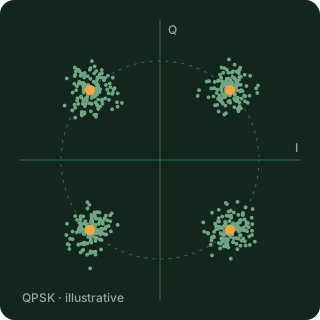
Illustrative QPSK constellation showing noisy received symbols around four ideal points
Illustrative QPSK constellation at moderate SNR. Received symbols (green) spread around the four ideal points (amber).
Noise
spreads each cluster. Near the sensitivity limit the clusters start to overlap, and acquisition has to work with very little signal.
Frequency offset
rotates the whole pattern. Carrier synchronization has to remove it, including the drift Doppler adds.
Quantization and timing error
widen the clusters further. Fixed-point and timing-recovery choices decide how much.
Services

What we can do for you

Engagements range from a focused design review to building and verifying a complete signal chain. Pick one area or combine them.

Digital signal processing

Algorithm development carried through to an implementable design.

  • Python, MATLAB and C++ modeling
  • FIR, CIC and polyphase filtering
  • Fixed-point conversion
More
  • DSP algorithm development
  • Multirate processing and digital downconversion
  • Automatic gain control
  • FFT-based processing
  • Detection and estimation
  • Resource-aware implementation

Communications and modems

Physical-layer design for digital links.

  • Digital modem architecture
  • Carrier and timing synchronization
  • Doppler compensation
More
  • BPSK, QPSK, OQPSK, FSK and CPM
  • Direct-sequence spread spectrum
  • Carrier-frequency estimation
  • Preamble acquisition and frame sync
  • Equalization and channel coding
  • Sensitivity and link-budget analysis
Digital modem development →

Software-defined radio and RF

RF hardware plus signal processing in software and FPGA logic.

  • SDR architecture and development
  • RF transceiver integration and bring-up
  • Digital front ends, DDC and DUC
More
  • FPGA-accelerated SDR processing
  • Waveform generation and reception
  • Multichannel processing
  • RF frequency planning
  • Embedded processor integration
  • SDR test and measurement automation
Software-defined radio →

FPGA implementation

Synthesizable designs that meet timing and match the model, bit for bit.

  • SystemVerilog and VHDL
  • Streaming DSP pipelines and AXI
  • Timing closure
More
  • Architecture and microarchitecture
  • DSP-slice and block-RAM optimization
  • Fixed-point arithmetic
  • Clock-domain crossing
  • Simulation and verification
  • Hardware-in-the-loop testing
FPGA development →

Software and firmware

The code that makes the signal chain usable in a real system.

  • Embedded C and C++
  • Python and DSP simulation
  • Host interfaces and device control
More
  • ARM and FPGA integration
  • Automated testing and FPGA build automation
  • Test-data analysis
  • SDR software integration

Consulting and research

Independent technical judgment when you need to decide what to build.

  • Architecture reviews
  • Feasibility and trade studies
  • SBIR and STTR technical development
More
  • Receiver performance analysis
  • FPGA resource estimation
  • Technical risk reduction and prototype architecture
  • Technical support for government R&D proposals
  • Subcontract technical support
RF testing

RF testing, measurement and validation

Northwest DSP supports RF and communications development through measurement planning, waveform analysis, automated testing and hardware-oriented verification. We connect simulation results with measured system performance to find implementation issues and validate communications designs.

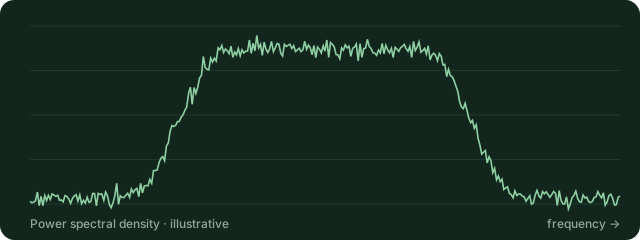
Illustrative power spectrum of a pulse-shaped signal above the noise floor
  • Receiver sensitivity characterization
  • BER versus Eb/N0 testing
  • Spectrum and waveform analysis
  • I/Q capture and analysis
  • Carrier-frequency-offset testing
  • Doppler impairment testing
  • Timing and synchronization measurements
  • SDR-based signal generation
  • RF test automation
  • FPGA hardware validation
  • Hardware-in-the-loop testing
  • Measurement-data processing

Testing is scoped around the required frequency range, measurement accuracy, and available instrumentation. Depending on the project, equipment may be provided by Northwest DSP, furnished by the customer, or acquired specifically for the engagement. Northwest DSP does not provide accredited or certification testing.

Simulation-based validation

Communications performance analysis using controlled channel and impairment models.

SDR-based prototyping

Waveform generation, capture, processing and automated analysis.

Laboratory measurement support

Measurement automation and testing with equipment provided by Northwest DSP, furnished by the customer, or acquired for the engagement.

Approach

From requirements to verified hardware

Each stage produces something you can review and keep. You see the design converge, and nothing important lives only in one person's head.

Step 1

Model

Requirements, link budget and a floating-point reference model that defines correct behavior.

Step 2

Fixed-point

Word lengths and quantization chosen and checked against the reference, with the margins documented.

Step 3

RTL

Synthesizable RTL, constraints and vendor IP configuration, closed against timing on the target part.

Step 4

Verify

Bit-true comparison against the model in simulation, then on hardware in the lab.

Verification covers

  • Algorithm performance
  • Fixed-point accuracy
  • RTL equivalence to the model
  • FPGA resource utilization
  • Timing closure
  • Hardware validation

Typical deliverables (scoped per project)

  • Floating-point reference model
  • Fixed-point model
  • RTL source and constraints
  • Testbenches and stimulus files
  • FPGA image and build reports
  • Host software and interfaces
  • Reproducible build instructions
  • Plots and technical report
  • Demonstration on hardware
Who we work with

Built for research programs and product teams

Government research

Small-business research and development under SBIR and STTR, either directly or as part of a team with a prime contractor or university.

Prime contractors

Subcontract support for defense, aerospace and communications programs that need focused DSP, RF or FPGA capacity.

Commercial teams

Product companies that need a signal chain designed, implemented or reviewed, without hiring a full-time specialist.

Applications and industries

Aerospace and satellite communications

  • Satellite modem development
  • Doppler compensation
  • Low-SNR signal acquisition
  • Telemetry processing
  • FPGA-based communications
  • SDR payload prototyping

Flight-test telemetry

  • Telemetry waveform development
  • Synchronization
  • Signal generation
  • BER testing
  • Distributed timing

Defense and government R&D

  • Communications research
  • FPGA signal processing
  • SDR prototypes
  • Technical feasibility studies
  • Subcontract technical support

Commercial wireless and SDR

  • Custom radio systems
  • Modem development
  • SDR integration
  • Receiver optimization
  • RF test automation
  • Embedded communications systems
Working with us

How an engagement works

Direct access

You work directly with the person doing the work. No account managers and no handoffs between a sales team and a delivery team.

Model to hardware

One person keeps the thread from the first equation to the bitstream, so the requirements and the implementation stay in agreement.

Clear terms

Each project has a written statement of work with defined deliverables, milestones and intellectual property terms, so you know what you are getting and what rights you receive.

Ways to start

Most work begins with one focused, fixed-scope step. Each is scoped and quoted in writing.

Technical architecture review

An independent review of a proposed or existing signal chain, with findings and recommendations in a written report.

Algorithm feasibility study

Simulation that shows whether an approach can meet the requirement, and roughly what it will cost in hardware.

FPGA optimization assessment

A review of an existing design's resources, timing and fixed-point choices, with ranked changes to recover margin.

Receiver performance investigation

Finding where a receiver loses performance by comparing the model, the RTL and measured data.

Prototype development

A working prototype of a waveform, modem or SDR function, carried from model to hardware within an agreed scope.

About

Mike Imhof, Founder

Mike Imhof founded Northwest DSP to provide specialized expertise in digital signal processing, communications systems, software-defined radio and FPGA development.

His technical work focuses on the design and implementation of communications algorithms and modem architectures, including synchronization, signal acquisition, digital receiver processing and resource-efficient FPGA implementations.

His approach covers the complete development process, from mathematical modeling and simulation through fixed-point analysis, RTL implementation, verification and hardware integration. Clients of Northwest DSP work directly with Mike on communications systems for aerospace, defense and commercial applications.

More about Mike and Northwest DSP →
Contact

Have a challenging communications problem?

Whether you need a DSP algorithm developed, an FPGA implementation optimized, an SDR prototype integrated, or an existing communications system evaluated, Northwest DSP can help.

General inquiriesoffice@nwdsp.com

Mike directlymike@nwdsp.com

Please don't include classified, CUI, export-controlled or proprietary details. We can arrange an NDA before technical discussions. See our privacy policy.